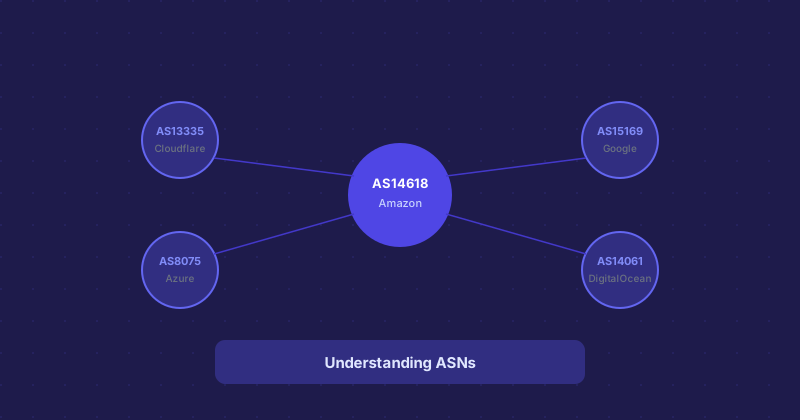
What is an ASN and Why Does It Keep Showing Up in Hosting Lookups
When you run a hosting lookup, one of the fields that comes back is the ASN — the Autonomous System Number. Most people glance at it and move on. It is actually one of the more useful fields if you know how to read it.
What an ASN Is
An Autonomous System is a network under a single administrative control — a company, an ISP, a university, a cloud provider. Every AS has a unique number assigned to it. AWS has several (AS14618 and AS16509 are the main ones). Google has its own (AS15169). Cloudflare has AS13335. These numbers are globally unique and publicly registered.
The Internet routes traffic between autonomous systems. When your packet travels from your laptop to a server at AWS, it hops through multiple ASes on the way.
Why Hosting Checkers Use ASNs
IP addresses alone do not tell you much. If you see the IP 52.44.173.32, you probably do not know off the top of your head that it belongs to AWS. But if you look up which AS that IP belongs to, you get AS14618 — and from there, the organization name "Amazon Technologies" is in the public registry.
Hosting checkers (including this one) maintain a curated database mapping ASNs to recognizable provider names. That is how "AS14618" becomes "Amazon Web Services" in the result you see.
When Multiple ASNs Mean the Same Provider
Large cloud providers operate multiple ASNs, sometimes for different services or regions. AWS has well over a dozen. Google Cloud and Azure both have several. A good hosting database handles this mapping, but it is worth knowing that seeing an unfamiliar ASN does not necessarily mean an unknown provider.
RDAP: The Modern Way to Look Up ASN Data
WHOIS for IP addresses is being replaced by RDAP (Registration Data Access Protocol), a structured, machine-readable API maintained by the regional internet registries (ARIN, RIPE, APNIC, etc.). RDAP responses include ASN information, organization name, CIDR block, and contact data in a consistent format that is much easier to parse than raw WHOIS text.
Practical Uses for ASN Data
- Identify whether a suspicious IP belongs to a known cloud provider vs. a residential ISP (relevant for bot detection)
- Map out your own infrastructure dependencies
- Research whether competitors use specific CDNs or cloud providers
- Geolocation and routing troubleshooting