What Is a Web Application Firewall and Do You Actually Need One
A Web Application Firewall (WAF) inspects HTTP and HTTPS traffic to and from a web application and blocks requests that match patterns associated with attacks. Unlike a network firewall, which operates at the IP and port layer, a WAF operates at the application layer and understands HTTP — it can examine request headers, query parameters, POST body content, and response data to identify malicious patterns. WAFs have moved from being a tool primarily used by large enterprises to being widely available, often as a feature of CDN and hosting products. Understanding what they do and what they do not do helps you decide whether to use one and how much to rely on it.
What Attacks a WAF Typically Blocks
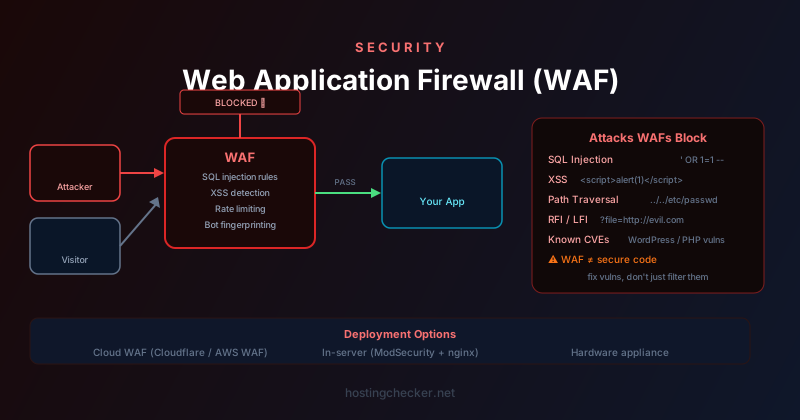
WAFs are primarily designed to detect and block the OWASP Top 10 categories of web application attacks. SQL injection — where an attacker inserts SQL syntax into a request parameter to manipulate a database query — is the classic example. A WAF that sees a query parameter containing ' OR 1=1 -- can block the request before it reaches the application. Cross-site scripting (XSS) — where an attacker injects script tags or JavaScript into user-supplied input that is then rendered in other users' browsers — is another primary target.
WAFs also commonly protect against path traversal attacks (requests that try to access files outside the web root using ../ patterns), remote file inclusion, and known exploit payloads for specific vulnerabilities in popular web software like WordPress, Drupal, or Magento. The ModSecurity Core Rule Set, an open-source rule set used by many WAFs, contains thousands of rules targeting known attack patterns. Cloud WAFs from providers like Cloudflare, AWS, and Imperva maintain proprietary rule sets that are updated as new vulnerabilities emerge.
How WAFs Work: Signature-Based and Anomaly-Based
Signature-based WAFs compare requests against a library of known attack patterns. This works well for attacks with distinctive patterns (SQL injection and XSS both have recognisable structures) but fails against novel attacks and can be bypassed by obfuscation. An attacker who knows what signatures a WAF is looking for can sometimes encode or obscure their payload to avoid matching any rule while still being decoded correctly by the vulnerable application.
Anomaly-based WAFs establish a model of normal traffic and flag deviations. A request with an unusually large body, an unusual number of parameters, or parameters with unusual character distributions might be flagged even if it does not match any specific attack signature. Machine learning models trained on large volumes of traffic can identify suspicious patterns that signature rules miss. Most enterprise WAFs use a combination: signature matching for known attack patterns and anomaly detection for unknown ones.
Where WAFs Sit in the Architecture
WAFs can be deployed in several positions. A network-based WAF runs as dedicated hardware or a virtual appliance in front of the web server, inspecting traffic before it reaches the server. An application-based WAF runs as a module inside the web server — ModSecurity running inside Apache or nginx is this model. A cloud-based WAF (Cloudflare WAF, AWS WAF, Fastly WAF) sits at the edge of a CDN network and filters traffic before it reaches your infrastructure at all.
Cloud-based WAFs have become the most widely accessible option. When you proxy your site through Cloudflare, for example, all traffic passes through Cloudflare's network, and the WAF can inspect it before forwarding to your origin. The advantage is that you do not need to install anything on your server. The disadvantage is that your origin must trust the WAF proxy, and if attackers can discover and directly access your origin IP address (bypassing Cloudflare), the WAF provides no protection for those requests.
False Positives: The Operational Cost of WAFs
WAFs are not free. Beyond the licensing or subscription cost, the operational cost of a WAF is the time spent managing false positives — legitimate requests incorrectly blocked by the WAF. A rule designed to catch SQL injection might block a support ticket that legitimately contains SQL syntax in its body. A form that accepts rich text might trigger XSS rules. An API that accepts JSON with nested structures might exceed anomaly score thresholds.
Running a WAF in detection mode (logging but not blocking) before switching to prevention mode (actually blocking) is the standard approach to understanding false positive rates before they affect users. Tuning rules for your specific application — disabling overly broad rules, creating exceptions for legitimate traffic patterns, and adjusting anomaly score thresholds — is an ongoing process. For applications with complex input requirements (rich text editors, code submission forms, advanced search syntax), WAF tuning can be substantial work.
What WAFs Cannot Do
WAFs are not a substitute for writing secure code. A WAF can block many attack attempts, but a sufficiently creative attacker can often find ways around signature rules. Logical vulnerabilities — where the application has correct syntax but incorrect business logic, like an order that can be placed with a negative quantity — are invisible to a WAF because they do not match any attack pattern. Authentication weaknesses, insecure direct object references, and privilege escalation vulnerabilities are similarly outside the scope of what a WAF can detect.
The security model of a WAF is defence in depth: it makes exploitation harder and buys time to patch vulnerabilities, but it is not a substitute for the vulnerabilities not existing in the first place. A site with a SQL injection vulnerability in its login form that is protected by a WAF is more secure than one without the WAF, but the correct long-term fix is to use parameterised queries in the application so the vulnerability does not exist, not to rely on the WAF to catch every possible exploit attempt.
When a WAF Is Worth It
For most small websites, the WAF built into Cloudflare's free tier provides a meaningful baseline of protection against automated scanning and commodity attacks with essentially no operational cost. The rule set handles the most common attack patterns and is maintained by Cloudflare without any action needed on your part. This is the right level of WAF for a blog or small business site.
For applications that handle sensitive data, process financial transactions, or are subject to compliance requirements like PCI DSS, a properly configured and tuned WAF is part of the expected security posture. PCI DSS explicitly requires either a WAF or a code review demonstrating applications are not vulnerable to the OWASP Top 10. For these applications, the investment in a commercial WAF product and the operational work of tuning it is justified by the risk reduction and compliance value it provides.