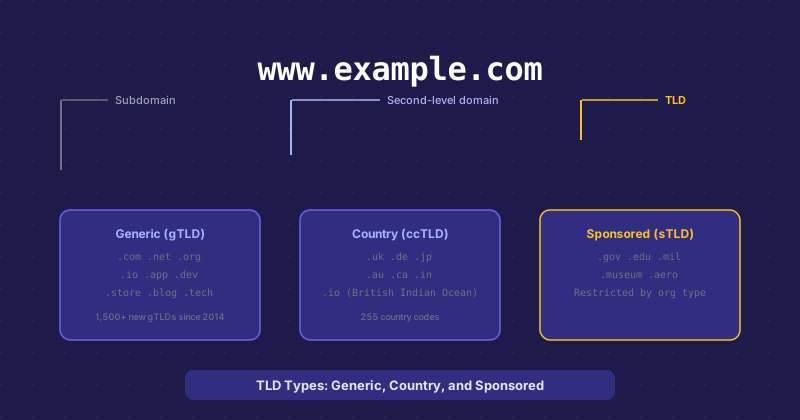
What is a TLD and How New Domain Extensions Changed the Internet
The TLD — Top Level Domain — is the final segment of a domain name. In example.com, the TLD is .com. In charity.org, it is .org. For decades, the list of available TLDs was short and familiar. Since 2013, ICANN opened the gates to over 1,500 new generic TLDs, and the domain landscape changed significantly. Here is the full picture.
The Structure of a Domain Name
Domain names are read right to left in terms of hierarchy. The TLD (rightmost) is at the top of the DNS hierarchy, directly below the root. To its left is the second-level domain — the part you register (like "example"). Further left are subdomains (like "www" or "api"). The TLD registry manages who can register in their namespace and sets the rules for eligibility.
Generic TLDs: The Original Seven
The original gTLDs created in 1985 were: .com (commercial), .org (organizations), .net (network), .int (international organizations), .edu (US educational institutions), .gov (US government), and .mil (US military). Of these, only .edu, .gov, and .mil remained restricted. .com, .org, and .net became open to anyone, with .com quickly dominating commercial registration.
Country Code TLDs
Each country has a two-letter ccTLD assigned by ISO 3166-1: .uk for the United Kingdom, .de for Germany, .jp for Japan, .au for Australia. Some ccTLDs have found second lives as generic alternatives — .io (British Indian Ocean Territory) became popular with tech companies and startups, .co (Colombia) markets itself as a .com alternative, .tv (Tuvalu) is used by streaming and media companies. The small nations that hold these valuable two-letter codes earn registration fees from commercial use.
The New gTLD Expansion
In 2011, ICANN approved a dramatic expansion of the TLD space, allowing applications for any string as a TLD. The first new gTLDs delegated in 2013 opened a wave that has now produced over 1,500 active new TLDs: .app, .dev, .io, .store, .shop, .blog, .tech, .design, .cloud, .online, .site, .agency, .marketing, and hundreds more including branded TLDs like .google and .amazon.
This expansion gave businesses options beyond the crowded .com space and allowed more descriptive domain choices. A design studio can register studio.design instead of thedesignstudio2023.com. A developer can register a short .dev domain. A retail business can use a .shop or .store domain that communicates purpose immediately.
Does the TLD Matter for SEO?
Google has consistently stated that the TLD itself does not affect search ranking. A .io or .co domain ranks the same as an equivalent .com domain, all else being equal. Country-code TLDs can influence local search — a .de domain may rank better in German search results — but generic new TLDs like .io or .app carry no inherent SEO penalty or advantage. Brand strength, content quality, and backlinks are what matter, not the extension.
The .com Advantage That Remains
Despite the expansion, .com retains significant advantages that are not going away soon. User trust and recognition are real: people expect .com and will type it by default when trying to reach a site they half-remember. Type-in traffic (people guessing URLs) defaults to .com. Email deliverability can be slightly affected by unusual TLDs in some spam filters. And if your brand is on .io and someone else registers the .com, you will lose direct navigation traffic forever.
For a new project with a strong brand name, a relevant new gTLD is entirely viable. For a business where domain authority and direct navigation matter significantly, the .com is still worth the extra effort to obtain.