What is a Dedicated Server and Who Actually Needs One
Shared hosting, VPS, and dedicated servers form a spectrum of increasing isolation and cost. At the top of that spectrum is the dedicated server — one physical machine, all resources yours, no other customers on the same hardware. Here is what that actually means and when it makes sense.
The Fundamental Difference
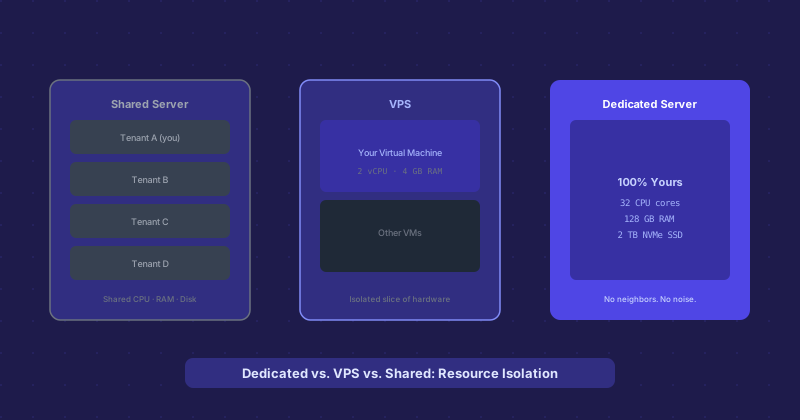
On shared hosting, dozens of websites share one server. On a VPS, your virtual machine shares underlying physical hardware with other VMs but has dedicated resource allocations. On a dedicated server, the physical machine — its CPUs, all the RAM, every disk — belongs to you. No other customer has any presence on that hardware.
This distinction matters in several ways. Performance is completely predictable because there are no neighboring tenants consuming resources. Security isolation is stronger because there is no hypervisor or shared kernel to attack across tenant boundaries. Compliance requirements that mandate physical isolation (certain healthcare, financial, and government environments) can be met. And full root access means you can install any software, configure the kernel, and run processes that require bare-metal access.
What You Get
Entry-level dedicated servers today typically offer 4–8 CPU cores, 16–32 GB of RAM, and 1–4 TB of SSD or HDD storage, for $60–120 per month from providers like Hetzner, OVH, or Leaseweb. Mid-range configurations go to 16–32 cores, 64–128 GB RAM, and NVMe storage. High-end servers for database workloads or compute-intensive applications can have 64+ cores and 256+ GB of RAM.
Bandwidth on dedicated servers is typically much higher than shared or VPS plans — 1 Gbps unmetered (or with a very large monthly allowance of 10–30 TB) is standard. This is relevant for high-traffic sites, media streaming, or applications that transfer large amounts of data.
Managed vs. Unmanaged Dedicated Servers
An unmanaged dedicated server means the host handles the hardware and network infrastructure, and you handle everything else — OS installation, security patches, software configuration, backups, and incident response. This requires solid Linux administration skills. Managed dedicated servers include OS-level management, security patching, monitoring, and often application support, at a significantly higher price. Many mid-market businesses use a managed dedicated server so they get the performance and isolation without needing an in-house sysadmin.
Who Actually Needs a Dedicated Server
High-traffic sites where a single VPS has become a bottleneck are the clearest use case. An e-commerce site doing millions of page views per month, a SaaS application with thousands of concurrent users, or a media platform streaming video to large audiences all have workloads where dedicated hardware is appropriate. Game servers, where latency and consistent performance matter and CPU resources are heavily utilized, are another common use case. Database servers for demanding applications benefit from dedicated hardware and the ability to tune OS-level settings like huge pages and I/O schedulers.
Compliance-driven environments are a distinct category. PCI DSS, HIPAA, and certain government security standards require physical isolation between tenants that only a dedicated server can provide. If your compliance framework mandates it, the business case is straightforward regardless of traffic levels.
Alternatives Worth Considering First
Before jumping to a dedicated server, consider whether a high-memory or CPU-optimized VPS covers your needs. A $100/month dedicated server from a budget host often has older hardware and worse network connectivity than a $100/month high-performance VPS from a provider like Hetzner Cloud or DigitalOcean. The VPS will also scale more easily — you can resize it, add block storage, or spin up additional instances without waiting for hardware provisioning. Dedicated servers make the most sense when consistent bare-metal performance, physical isolation, or compliance requirements are driving the decision, not just raw cost-per-resource comparisons.