What Does a Domain Registrar Actually Do (and Why It Matters Which One You Use)
A domain registrar is the company you pay to register a domain name. That much is obvious. What is less obvious is what they actually do, why the choice of registrar matters more than most people think, and what the relationship between registrar and registry actually looks like.
Registrars vs. Registries
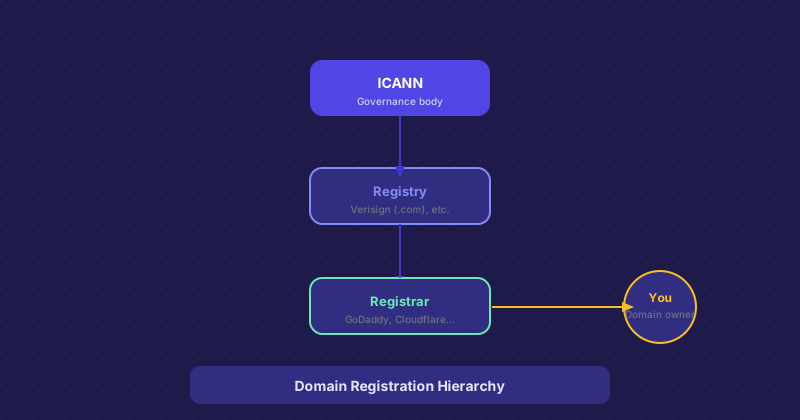
The registry is the organization that runs a top-level domain. Verisign runs .com and .net. Nominet runs .uk. ICANN accredits registrars to sell domain registrations to the public on behalf of these registries. When you register a domain, the registrar submits the registration to the registry. The registry is the actual authoritative record. The registrar is your access point to that record.
This means your domain ultimately exists in the registry's database, not your registrar's. If your registrar went out of business overnight, your domain would still exist — you could transfer it to another registrar. This is good to know.
What Registrars Actually Provide
Beyond the registration itself, registrars typically provide:
- DNS hosting — the nameservers that tell the world where your domain points
- WHOIS privacy — masking your personal contact information from public WHOIS lookups
- Domain locking — preventing unauthorized transfers
- Auto-renewal management
- Transfer authorization codes (EPP codes) for moving domains
Some registrars also sell hosting, email, website builders, and SSL certificates. These add-ons vary wildly in quality and price.
Why the Choice of Registrar Matters
At the low end, some registrars make money through aggressive upselling, confusing interfaces that trick you into buying add-ons, and pricing that looks cheap for year one and jumps on renewal. Others have poor customer support or security practices.
At the practical level, a domain locked in a registrar with a bad transfer process can take weeks to move. If your registrar is unresponsive or makes it difficult to obtain your EPP transfer code, you are stuck. This has happened to businesses during critical periods.
What to Look For
Renewal pricing matters more than first-year pricing. Check what year two costs, not just year one. Look for registrars that include WHOIS privacy for free (Cloudflare Registrar and Porkbun do; GoDaddy charges extra). Two-factor authentication on your account is non-negotiable — your domain is a high-value asset and should be protected accordingly.
DNS quality matters if you are using the registrar's nameservers. Some registrar DNS platforms are slow or lack features like TTL customization. Many people register at one registrar and point nameservers to a dedicated DNS provider like Cloudflare for better performance and more control.
Transferring a Domain
Domain transfers take a minimum of 5 days due to ICANN policy, though most complete faster. You need an EPP auth code from the current registrar, the domain must be unlocked, and it must not have been transferred or registered within the last 60 days. WHOIS privacy must be disabled (or the email behind it accessible) so the transfer confirmation email reaches you.
Transfer pricing varies. Some registrars charge full renewal price for a transfer; others (Cloudflare, Porkbun) charge at-cost. The transfer renews the domain by one year, so it is worth factoring that in.