Understanding Web Hosting Uptime Guarantees: What the Numbers Actually Mean
Almost every web hosting company advertises uptime guarantees. You will see numbers like 99.9%, 99.99%, and occasionally the aspirational 100%. These numbers sound impressive but they are easy to misread. Understanding what they actually mean in practice will help you choose the right hosting for your needs and set realistic expectations.
The Maths Behind the Percentages
Uptime percentages become much more tangible when you convert them to actual downtime per year. The numbers are surprising to most people who have not done the calculation before.
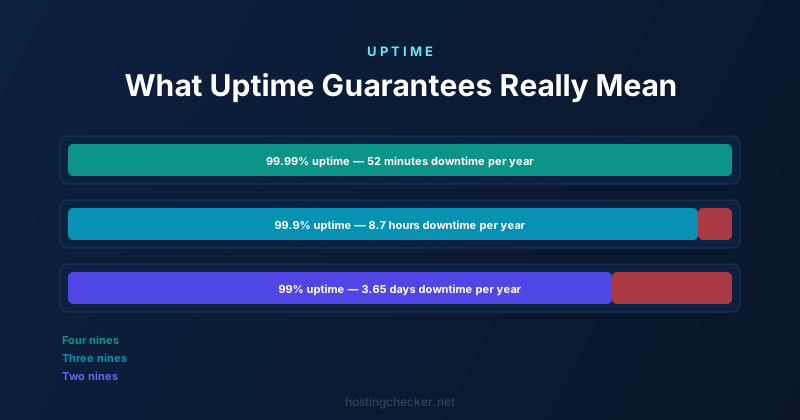
99% uptime sounds good until you realise it allows for 3.65 days of downtime per year. That is 87.6 hours. For any commercial website, three and a half days offline in a year would be catastrophic.
99.9% uptime, the most commonly advertised tier, allows for 8.76 hours of downtime annually. That is about eight hours and 46 minutes per year. On a monthly basis that works out to roughly 43 minutes. Still significant for a business that relies on its site.
99.99% uptime, often called four nines, allows for just 52 minutes of downtime per year, or about 4.3 minutes per month. This is the tier where most e-commerce and SaaS companies try to operate.
99.999%, five nines, allows for only 5.26 minutes of downtime per year. This is the territory of large enterprise infrastructure and is rarely offered by standard web hosting providers.
What Counts as Downtime
The definition of downtime in a hosting SLA is not always what you might expect. Many hosting companies define downtime as a period where their servers are completely unreachable, measured from their own monitoring systems. Slow response times, partial outages affecting only some users, and degraded performance usually do not count as downtime under standard SLA definitions.
Planned maintenance windows are almost universally excluded. If your host takes the server down at 3am on a Sunday to perform upgrades, that typically does not count against your uptime guarantee even if it takes two hours. Read the fine print about maintenance exclusions before signing up.
SLA Credits Are Not Compensation
When a host fails to meet their uptime SLA, the standard remedy is a service credit, usually a pro-rated portion of your monthly fee for the downtime period. If your hosting costs forty dollars a month and you experience two hours of downtime that violates the SLA, you might receive a credit of a few cents to a few dollars.
This is not compensation for lost revenue, damaged reputation, or the time you spent troubleshooting. For a business that generates meaningful revenue online, the actual cost of two hours of downtime likely exceeds the entire value of the hosting plan. SLA credits are a token gesture, not a real insurance policy.
How Hosts Achieve High Uptime
The infrastructure behind high uptime guarantees involves redundancy at multiple levels. Redundant power supplies with UPS systems and diesel generators. Redundant network connections from multiple providers. RAID storage arrays so that disk failures do not cause data loss. Multiple physical servers so that hardware failures can be handled by routing traffic elsewhere.
Better hosting providers also run active health monitoring and automated failover. If a server stops responding, the system automatically redirects traffic to a standby server within seconds rather than waiting for a human to notice and intervene. The difference in effective uptime between a provider with automated failover and one without can be significant.
What Your Architecture Contributes
The host is only one part of the uptime equation. If your entire site runs on a single server with no failover, then a single hardware failure takes you down regardless of what the SLA says about the hosting provider doing their best. Architecting for redundancy, using load balancers, keeping database replicas, and using a CDN as a buffer between users and your origin server all contribute to real-world uptime independently of what the host guarantees.
Choosing the Right Uptime Tier
A personal blog or portfolio site can live comfortably on standard shared hosting with 99.9% uptime. A few hours of downtime per year is an acceptable trade-off for the cost savings. An e-commerce store that does meaningful sales volume should be looking at VPS or cloud hosting with at minimum 99.9% and ideally 99.99% uptime. A business where revenue directly depends on site availability every hour of every day needs to treat infrastructure uptime as a first-class concern, which means dedicated or cloud infrastructure with active failover and a disaster recovery plan.