IPv4 vs. IPv6: What the Transition Actually Means for Website Owners
IPv6 has been "the future" for so long it has become something of a running joke in networking circles. But adoption has crossed meaningful thresholds in the last few years, and if you run a website, there are practical implications worth understanding.
The Address Exhaustion Problem
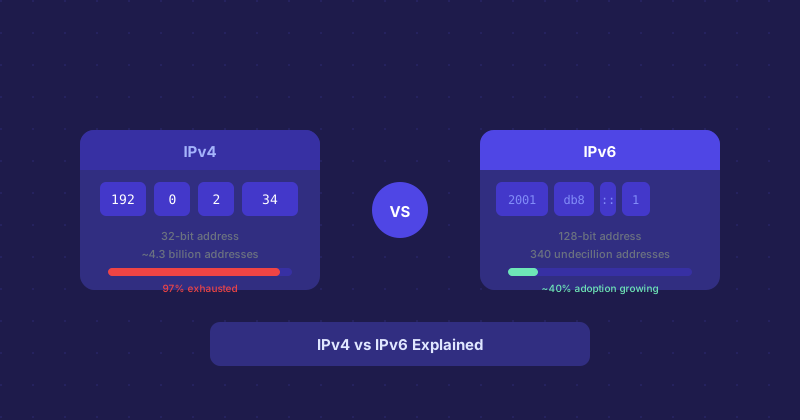
IPv4 uses 32-bit addresses, giving roughly 4.3 billion possible addresses. That sounds like a lot until you realize there are over 15 billion internet-connected devices today. The global IPv4 address pool was officially exhausted in 2011. Since then, organizations have been trading, recycling, and in many cases relying on NAT (network address translation) to stretch the remaining space.
IPv6 uses 128-bit addresses. The address space is 340 undecillion. For practical purposes, it does not run out.
Dual-Stack: How Most of the Internet Works Now
Most modern infrastructure runs what is called dual-stack — IPv4 and IPv6 simultaneously. A domain might have both an A record (IPv4) and an AAAA record (IPv6). Clients that support IPv6 will use it preferentially; clients that only support IPv4 fall back to the A record. This is the recommended configuration.
What This Means for Your Website
If your hosting provider gives you an IPv6 address (most modern providers do), add a AAAA record in DNS. This ensures users on IPv6-only networks can reach you without any NAT translation overhead. Check your current DNS records with a DNS lookup tool to see if you already have one.
ISP-Level Adoption Varies Wildly
IPv6 adoption is uneven by country. The US is around 50% IPv6 traffic across major ISPs. India is higher. Germany is very high. Japan and China are lower. The implication: your users are more likely to be accessing you over IPv6 than you might expect, particularly on mobile networks (many carriers have moved to IPv6-only internally).
The Hidden Benefit: No NAT Overhead
One underappreciated advantage of IPv6 is the end-to-end connectivity model. With IPv4 behind NAT, intermediate devices have to track connection state and translate addresses at every step. IPv6 connections are direct. For latency-sensitive applications, this matters.
Do You Need to Do Anything Today?
For most website owners: add a AAAA record if your host gives you an IPv6 address, and you are done. The complexity of managing IPv6 is largely absorbed by your hosting provider and DNS service. You are mostly just enabling a capability that is increasingly expected.